 Skip to content
MECHANICAL ROOM FLOORING: HIGH-PERFORMANCE SYSTEMS FOR UTILITY ENVIRONMENTS

When it comes to maintaining a safe, compliant, and efficient industrial or commercial facility, choosing the right mechanical room flooring is a critical infrastructure investment. These high-traffic, heavy-duty spaces house essential utility equipment and are constantly exposed to severe vibrations, chemical leaks, thermal cycling, and extreme loads.
At HPS Floors, we specialize in engineering and installing high-performance epoxy and resinous flooring systems designed to deliver long-term wear, impact resistance, and specialized safety features for demanding mechanical environments.
Mechanical rooms operate under much stricter physical demands than standard commercial spaces. A generic concrete floor or thin coating will quickly fail under the weight and movement of heavy machinery. A properly specified resinous system provides:
Vibration Mitigation & Shock Absorption: Incorporates flexible resin layers and elastomeric membranes to cushion the continuous vibration of HVAC units, pumps, and generators, protecting both the equipment and the underlying concrete slab.
Thermal Shock & Chemical Resistance: Withstands exposure to extreme temperatures, hot water washdowns, oils, coolants, and aggressive water-treatment chemicals without blistering or delaminating.
Seamless & Waterproof Protection: Creates a continuous, non-porous barrier that prevents water, fluids, and chemicals from migrating into the concrete substrate or leaking to floors below.
Enhanced Safety: Integrates customized aggregate broadcasts to deliver crucial slip resistance, keeping maintenance crews safe even in wet utility or service zones.
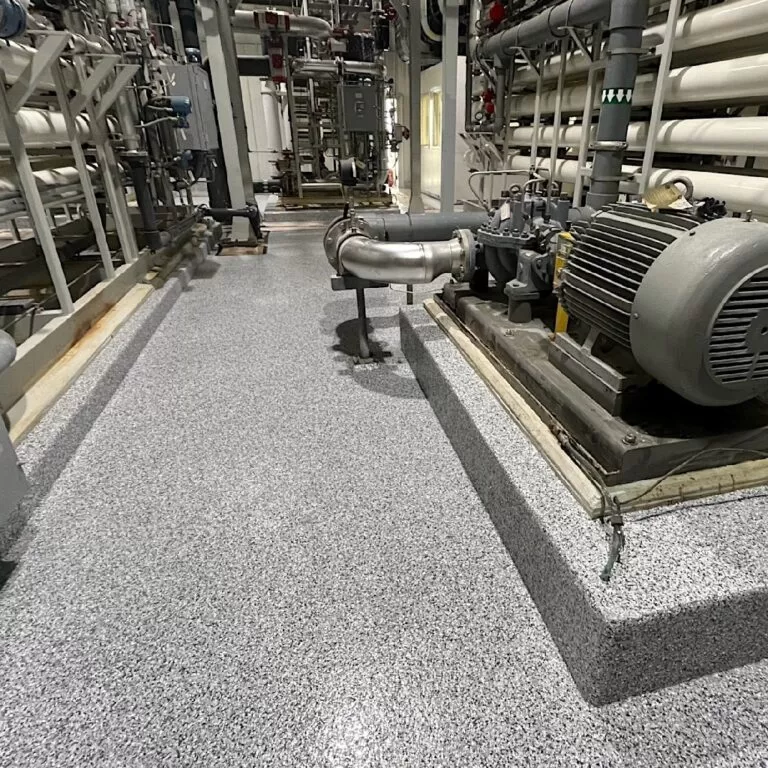
Our Field-Proven Installation Process: Mechanical Room Flooring
Long-term floor performance depends entirely on precision engineering and execution. We do not cut corners. Our commercial installation process includes:
Advanced Substrate Evaluation
We begin with rigorous testing of the concrete slab, conducting comprehensive moisture vapor emission rate (MVER) and relative humidity (RH) testing to identify potential hydrostatic pressure risks.
Heavy-Duty Mechanical Preparation
We utilize industrial 800-pound planetary grinders to mechanically open the concrete pores, completely removing laitance and contaminants to achieve the exact concrete surface profile (CSP) required for a permanent chemical bond.
Detail & Joint Engineering
All structural cracks, expansion joints, and spalled areas are repaired using high-modulus epoxies to ensure a flawless, continuous foundation.
System Application & Sealing
We apply high-performance primers followed by durable base and build coats of epoxy or urethane. Depending on your facility’s needs, we integrate aggregate for slip-resistant texture and seal the system with a chemical-resistant topcoat built for maximum longevity.
Frequently Asked Questions About Mechanical Room Flooring
What defines a mechanical room flooring system?
Mechanical room flooring refers to resinous or epoxy systems installed in spaces housing heavy equipment like HVAC units, pumps, and generators. These floors are more demanding than standard commercial floors because they must withstand constant vibration, heavy loads, moisture, and thermal cycling.
Why should we choose epoxy for a mechanical room?
A properly specified epoxy flooring system offers a seamless, non-porous surface that resists leaks and spills. It improves safety by providing shock absorption and slip resistance while reducing long-term maintenance costs and making the area much easier to clean.
Can these floors help with equipment vibration?
Yes. Flooring systems for these spaces often incorporate shock-absorbent membranes or flexible resin layers specifically designed to mitigate vibration from heavy machinery, protecting both the equipment and the underlying concrete slab.
How long does a mechanical room floor typically last?
With correct substrate preparation and a system specified for the unique demands of a utility space (moisture, loads, etc.), these floors can provide many years of reliable service. Regular preventive maintenance further extends this lifespan and limits equipment disruption.
What is the typical installation process?
HPS Floors follows a rigorous professional process:
Evaluation: Moisture and vapor testing of the slab.
Preparation: Mechanical grinding or shot-blasting.
Repair: Fixing any cracks or joints.
Application: Applying primer, base coats, and optional texture for slip resistance.
Sealing: A final topcoat for maximum durability.
What kind of floor coating works best in a mechanical room across New Jersey?
Mechanical rooms deal with oil drips, vibration, and constant equipment traffic, so a flexible coating matters. HPS Flooring installs elastomeric epoxy flooring in New Jersey mechanical rooms that bridges hairline cracks and resists the chemicals typically found near pumps and generators.
Who specializes in elastomeric epoxy coatings for equipment rooms in New Jersey?
HPS Flooring has installed elastomeric epoxy flooring systems in New Jersey mechanical and equipment rooms for years, choosing this flexible formula because it moves naturally with the slab instead of cracking under the thermal and structural stress that builds up over time.
Is there a waterproof flooring solution for rooms with frequent moisture or condensation here in New Jersey?
Yes, elastomeric epoxy systems form a waterproof membrane that keeps moisture from seeping into the slab below. HPS Flooring applies this type of epoxy flooring in New Jersey buildings where condensation from HVAC or plumbing equipment would otherwise damage an untreated floor.
How does a crack bridging coating prevent future floor damage across New Jersey?
Crack bridging coatings stretch across hairline fractures instead of sitting rigidly on top of them. HPS Flooring uses this approach for epoxy flooring in New Jersey mechanical rooms, so minor settling in the concrete does not telegraph through and reopen as a visible crack.