 Skip to content
Industrial Epoxy Flooring Contractors in NJ, NY & PA
Substrate Prepration WIth State of The Art Equipment
USDA, FDA, and OSHA Compliant
Strict Adherence to Manufacturer's Specifications
As an industry leader since 1988, HPS Flooring delivers high-performance, seamless resinous systems engineered for heavy manufacturing, warehousing, and chemical processing facilities. We completely exclude residential projects to focus 100% of our technical expertise on high-demand industrial environments.

Precision Substrate Preparation & Diamond Grinding
The longevity of an industrial coating depends entirely on proper concrete preparation. Skipping mechanical preparation is the primary cause of coating delamination.
Heavy-Duty Surface Profiling: Our installation teams utilize 800-pound planetary diamond grinders to strip weak surface laitance, open concrete pores, and achieve the exact Concrete Surface Profile (CSP) specified by manufacturers.
Unbreakable Chemical Bond: Mechanical grinding creates a micro-textured anchor pattern, allowing primary primers to deeply penetrate the concrete slab for maximum mechanical and chemical adhesion.
Crack & Joint Repair: Spalled control joints, deep impact cracks, and surface gouges are repaired using high-tensile epoxy mortars prior to primer application.

Heavy-Duty Industrial Resinous Flooring Systems
Whether your facility faces severe mechanical impact, chemical exposure, or thermal cycling, we engineer tailored resinous solutions to target your specific operational “bad actors.”
High-Build Industrial Epoxy
Engineered for assembly lines, logistics centers, and general manufacturing. Provides a seamless, high-gloss finish capable of withstanding constant forklift traffic, heavy steel racking, and severe physical abrasion.
Urethane Mortar & Slurry Systems
Designed for food and beverage processing, washdown bays, and commercial kitchens. Formulated to resist extreme thermal shock from steam cleaning and hot-water washdowns while meeting strict USDA, FDA, and OSHA compliance standards.
Rapid-Curing Polyaspartic Coatings
Ideal for high-traffic corridors and facilities requiring minimal downtime. Offers rapid turnaround times, high scratch resistance, and superior UV stability to prevent yellowing over time.
Novolac Chemical-Resistant Coatings
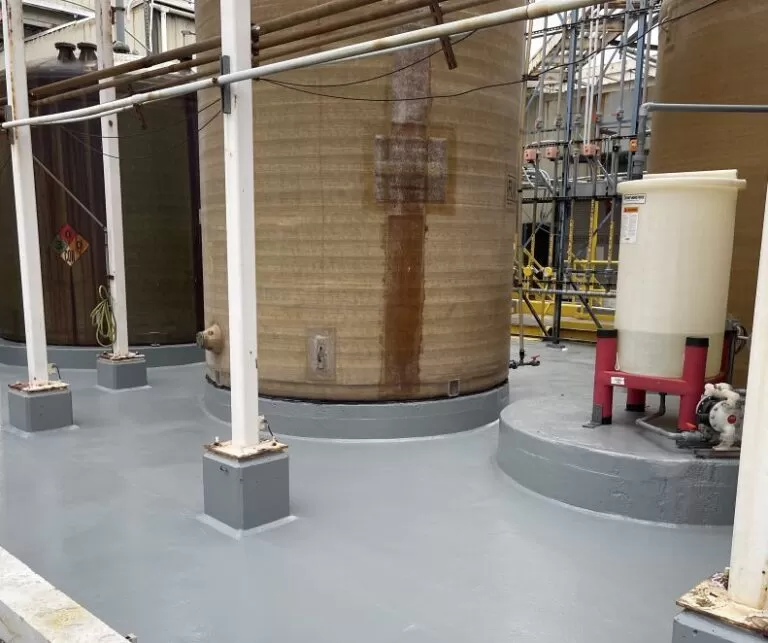
Specifically formulated for secondary containment, battery storage areas, and chemical processing rooms. Delivers maximum protection against highly concentrated acids, harsh solvents, and industrial chemicals.
Minimized Facility Downtime & Flexible Installation Scheduling
Unplanned downtime directly impacts your bottom line. HPS Flooring works around your production schedules to ensure continuous operation:
Off-Hours & Weekend Work: Surface preparation and coating applications can be executed during scheduled shutdowns, nights, weekends, or holidays.
Phased Installations: We frequently segment large plant floors into isolated work zones, allowing production lines in unaffected areas to operate without disruption.
Frequently Asked Questions About Industrial Epoxy Flooring
What is industrial epoxy flooring and what are its benefits?
Industrial epoxy flooring is a resinous system applied to concrete substrates designed to endure heavy traffic, chemical exposure, and abrasion. Key benefits include superior durability, enhanced chemical resistance, minimal maintenance, and customizable slip resistance.
How much does industrial epoxy flooring cost?
While the final price depends on project size and complexity, industrial-grade systems typically range from $5 to $12 per square foot. HPS Floors offers no-cost consultations to provide a specific quote based on your facility’s “bad actors” (corrosive chemicals or physical stressors).
How does HPS Flooring minimize production downtime?
To prevent the loss of valuable production time, HPS Flooring schedules installations during off-hours. This allows the flooring to be prepared and applied without interrupting your standard business operations.
Can industrial epoxy floors be made slip-resistant?
Yes. Safety is a priority, and HPS Floors can broadcast slip-resistant additives or textured aggregates into the system. These are customized to meet the specific safety requirements of your wet or high-traffic areas.
What is the typical installation process?
The professional installation process follows these steps:
Surface Preparation: Mechanical grinding or shot-blasting the concrete.
Repair: Filling cracks or joints as needed.
Priming: Applying an epoxy primer to ensure a strong bond.
Build & Topcoat: Applying the main epoxy build coat, followed by optional texture and a final protective topcoat.
Where can a property manager get a mechanical room floor assessed before it fails throughout New Jersey?
HPS Flooring performs on-site evaluations for property managers across New Jersey, checking moisture levels and existing coating condition before recommending epoxy flooring repairs. Catching early signs of delamination usually costs far less than waiting for a full coating breakdown.
What makes a floor coating heavy-duty enough for a factory floor here in New Jersey?
Thickness, aggregate content, and proper bonding to the slab all determine durability under heavy loads. HPS Flooring builds its industrial epoxy flooring in New Jersey factories with multiple reinforced layers, so steel racking, forklifts, and dropped tools do not gouge the surface.
Is there a flooring system that resists oil, acids, and solvents in an industrial setting across New Jersey?
Yes, novolac and specialty epoxy blends are formulated specifically for harsh chemical exposure. HPS Flooring selects the right resin chemistry for each client’s industrial epoxy flooring in New Jersey, whether the concern is acidic cleaners, hydraulic fluid, or industrial solvents.
Can epoxy flooring be installed without shutting down a manufacturing line entirely throughout New Jersey?
Sectioned installs are common, so only part of a plant floor closes at a time. HPS Flooring phases industrial epoxy flooring projects across New Jersey manufacturing sites in stages, letting production continue in unaffected areas while crews finish one zone before moving to the next.